
Assessment · First assessment 2026
Paper 1: working with sources
Four unseen sources on the core topics, four compulsory questions and seventy-five minutes: what each question demands, how to spend the time, where marks are lost and how to build a strong answer to question 4.
Prescribed content
- Question 1: understanding of a source (AO1, 3 marks)
- Question 2: application of knowledge to analyse a source (AO2, 4 marks)
- Question 3: comparison and/or contrast of two sources (AO3, 6 marks)
- Question 4: evaluation of sources and synthesis with own knowledge (AO3, 12 marks)
Overview
Paper 1 looks like a comprehension exercise and is not one. It tests whether a candidate can turn unseen evidence into analysis and argument under time pressure. The paper is identical at SL and HL: 1 hour 15 minutes and 25 marks, worth 30 per cent of the SL grade and 20 per cent of the HL grade. Its content is the core topics, from framing global politics and power to theoretical perspectives, presented through four sources that may be text, images, diagrams or infographics. All four questions are compulsory.
The questions climb the assessment objectives: understanding, then application and analysis, then evaluation and synthesis. Questions 1 to 3 are marked against an analytical markscheme written for each paper; question 4 is marked with markbands as well, applied holistically. This page draws on the guide, the teacher support material and the Assessment Companion.
Inquiry questions
- What can a source not show, and how does that limit what you can conclude from it?
- How do a source's origin and purpose shape the claims it makes?
- When is a government's account of its own conduct useful evidence?
01Timing strategy
Timing is the most often cited technical failure on this paper: candidates over-invest in the cheap questions and reach question 4 with little time and no plan. A defensible allocation of 75 minutes:
- reading and annotating all four sources: about 8 minutes;
- question 1 (3 marks): about 6 minutes;
- question 2 (4 marks): about 9 minutes;
- question 3 (6 marks): about 15 minutes;
- question 4 (12 marks): about 37 minutes, including 5 minutes of planning.
While reading, label each source's argument in a few words in the margin, bracket short phrases worth quoting, draw arrows between sources that agree, disagree or extend one another, and mark where one of your own examples speaks to a source. That annotation is already the plan for questions 3 and 4.
02Question 1: understanding a source (3 marks, AO1)
Question 1 tests understanding of one source, for example by identifying elements in it or summarising what a diagram, map or table shows. Marks go to distinct, relevant points.
- Give three clear points for three marks, then stop. Extra points earn nothing and cost minutes.
- Draw points from what the source says or shows. Its origin is not a point of content, and describing its form ('it is a map') is not a point either.
- Read legends, scales and axis labels carefully; misreading a key loses the mark.
- A short quotation or close paraphrase is safer than a loose paraphrase that distorts the meaning.
03Question 2: applying knowledge to a source (4 marks, AO2)
Question 2 tests the application of knowledge to analyse a source, for example by explaining a term it uses or a claim it makes. Strong answers refer explicitly to the source and bring in knowledge from the course, typically a specific example the candidate has studied.
- Treat an example of your own as required. The Assessment Companion's reading of the markscheme is that an answer without one cannot reach full marks, and an 'example' lifted from another source in the paper is not your own.
- Make the example specific: name the actor, place and time, and show why it illustrates the term or claim.
- Explain rather than state. The marks lie in the connection between source, concept and case.
04Question 3: comparing and contrasting two sources (6 marks, AO3)
Question 3 tests comparison and/or contrast of the views, ideas, claims and information in two named sources. The guide expects a detailed running comparison or contrast for the highest marks.
- Obey the command term. 'Compare' asks for similarities, 'contrast' for differences, 'compare and contrast' for both.
- Write in running pairs: 'Whereas Source C presents sanctions as a tool of collective security, Source D treats them as great-power coercion.' Treating each source separately, one after the other, cannot reach the top marks.
- Aim for several distinct points, each anchored in both sources. A point restated in new words is not a second point.
- Skip introductions and conclusions, and compare ideas and claims rather than tone or authorship. Wider knowledge may supply context, but the marks are for the sources.
05Question 4: evaluation and synthesis (12 marks, AO3)
Question 4 asks candidates to evaluate the sources and synthesise relevant evidence from them with their own knowledge of the prescribed content, usually in response to a claim. It is worth almost half the paper. Read the instruction on how many sources to use and meet it exactly: answers built only on the sources, or only on own knowledge, are limited.
The top markband rewards, in effect, four things at once: relevant and accurate knowledge used throughout, genuine synthesis of own knowledge with source material, examples woven into the argument, and perspectives that are both explored and weighed. In practice:
- Plan for five minutes. Decide your judgement, the claims that support it, the counterclaim, and which sources and examples serve each.
- Interleave in every paragraph. Claim; short, correctly attributed source reference; a specific contemporary example of your own; what the two together show; how far the claim holds and where it does not.
- Evaluate the sources as evidence. Which is most relevant to the claim, and what can each not show? A government statement is a stakeholder's account of its own conduct; an NGO report is evidence and advocacy at once.
- Conclude with a judgement and its conditions, not a summary.
06How marks are lost
- Question 1: describing the source instead of drawing points from it; using provenance as a point; misreading a key.
- Question 2: no example of one's own, or one taken from another source; examples with no named actor or with inaccurate detail.
- Question 3: comparing when asked to contrast; treating sources one after another; repeating a point in new words.
- Question 4: summarising each source in turn and adding own knowledge at the end; claims without counterclaims; key terms never clarified; running out of time.
- Throughout: long quotation, narration with no purpose, and dated or hypothetical examples. In this course 'contemporary' means roughly the last two decades.
07A worked approach
Suppose the four sources concern regional organisations' responses to military coups: an official communiqué suspending a member state (A), a map of suspensions (B), a commentary arguing that suspension pushes military governments towards other partners (C), and a chart of aid flows before and after a coup (D).
- Question 1 might ask what Source B shows about the pattern of suspensions: three points from the map, such as the regions concerned, clustering in time and the number of states affected.
- Question 2 might ask you to explain Source A's claim that unconstitutional changes of government undermine regional legitimacy, using an example you have studied. Explain the claim, then develop a case of your own.
- Question 3 might ask you to contrast A and C. Run the contrast: A treats suspension as upholding a norm, C as weakening the organisation's leverage; A assumes members value their standing, C that a military government has alternatives.
- Question 4 might ask you to evaluate the claim that suspension is an effective response to coups. A strong plan argues that suspension upholds the norm but rarely restores civilian rule quickly; uses B and D for patterns and C for the counterclaim; adds one or two developed examples of your own; and concludes that effectiveness depends on whether the regime has outside patrons.
Key ideas
- The paper climbs from understanding (question 1) through analysis (question 2) to evaluation and synthesis (questions 3 and 4).
- Time follows marks: question 4 deserves about half the paper.
- Points come from a source's content, not its origin or form.
- Question 2 needs a specific example of your own, not one borrowed from another source.
- Question 3 is a running comparison or contrast, point by point.
- Question 4 interleaves sources and own knowledge in every paragraph and ends with a conditional judgement.
Common misconceptions
The misconception
Longer answers to question 1 earn more.
The correction
Three distinct points earn the three marks; more earns nothing and takes time from question 4.
The misconception
Origin and tone are good points of contrast in question 3.
The correction
Question 3 compares views, ideas, claims and information. Provenance belongs in the evaluation of evidence in question 4.
The misconception
Question 4 is a summary of the four sources.
The correction
It asks for evaluation and synthesis with your own knowledge; summarising the sources in turn is a common reason for low marks.
How it is assessed
Paper 1 (SL and HL): 1 hour 15 minutes; 25 marks; 30 per cent at SL, 20 per cent at HL. Four sources on the core topics and four compulsory structured questions: question 1 (3 marks, AO1), question 2 (4 marks, AO2), question 3 (6 marks, AO3), question 4 (12 marks, AO3). Questions 1–3 are marked with a paper-specific analytical markscheme; question 4 also uses markbands applied by best fit. See command terms.
Practice questions
- Q1IB Paper 1 style3 marks
Practice set on the Security Council veto. Assemble four sources: a statement defending a veto (A), a chart of vetoes cast since 2000 (B), a civil society statement on the General Assembly's 2022 'veto initiative' (C) and a cartoon (D). Identify three patterns shown in Source B.
How to approach it
Three distinct points from the chart's content, such as which members cast most vetoes, the trend over time and the issues concerned. Do not describe the chart's form.
- Q2IB Paper 1 style4 marks
With explicit reference to Source A and an example you have studied, explain why a permanent member might regard its veto as legitimate.
How to approach it
Use the source's own justification, connect it to a source of legitimacy (legality under the Charter, great-power responsibility), and develop a specific case of your own.
- Q3IB Paper 1 style6 marks
Compare and contrast the views of the veto presented in Sources A and C.
How to approach it
Running pairs of similarities and differences, each anchored in both sources; no introduction.
- Q4IB Paper 1 style12 marks
Using the sources and your own knowledge, evaluate the claim that the veto undermines the legitimacy of the Security Council.
How to approach it
Use at least three sources, interleaved with your own developed examples. Weigh procedural legitimacy against effectiveness, evaluate each source as evidence, and reach a conditional judgement.
Practice questions are original to this platform and are not IB examination questions.
Across the handbooks
Where this unit meets the nine original handbooks: the handbooks written for it, the others that take it up, and what each shares with it.
- 01Framing Global Politics
- 02Power
- 03Sovereignty
- 04Legitimacy
- 05Interdependence
- 06Theoretical Perspectives
- 07Rights & Justice
- 08Stakeholders & Actors
- 09Nature, Practice & Study
- Written for this unit
- Takes up this unit
- Shares its cases, concepts or thinkers
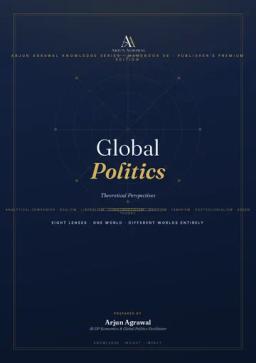
Handbook 06Written for this unit
Theoretical PerspectivesAn analytical companion to eight lenses on global politics
Leads on to: Theoretical perspectives in global politicsPaper 2: the essays
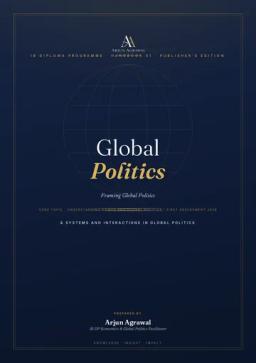
Handbook 01Written for this unit
Framing Global PoliticsSystems and Interactions in Global Politics
Leads on to: Framing global politicsPower in global politicsLegitimacy in global politicsThe engagement project
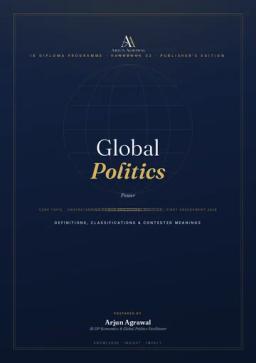
Handbook 02Written for this unit
PowerDefinitions, Classifications & Contested Meanings
Leads on to: Framing global politicsPower in global politicsTheoretical perspectives in global politics
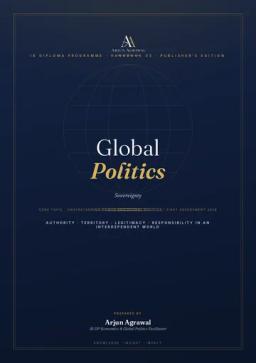
Handbook 03Written for this unit
SovereigntyAuthority · Territory · Legitimacy · Responsibility in an Interdependent World
Leads on to: Sovereignty in global politicsLegitimacy in global politicsInterdependence in global politicsPeace and conflict
Handbook 04Written for this unit
LegitimacyWhy People Obey — and What Happens When They Stop
Leads on to: Power in global politicsSovereignty in global politicsLegitimacy in global politics
Handbook 05Written for this unit
InterdependenceGlobal Governance, International Law & the Networked World
Leads on to: Sovereignty in global politicsLegitimacy in global politicsInterdependence in global politics
The handbooks are original to this platform. These links follow each handbook’s syllabus coverage and cross-references.
Explore further
Organisation
IB Global Politics
Political Issue Dossier
Sources
- 01International Baccalaureate, Diploma Programme Global politics guide (first assessment 2026), published February 2024, updated July 2024. International Baccalaureate Organization, 2024
- 02International Baccalaureate, Global politics teacher support material (first assessment 2026), March 2024. International Baccalaureate Organization, 2024
- 03Arjun Agrawal, Global Politics: The Assessment Companion