IB DP Global Politics Companions · No. 2
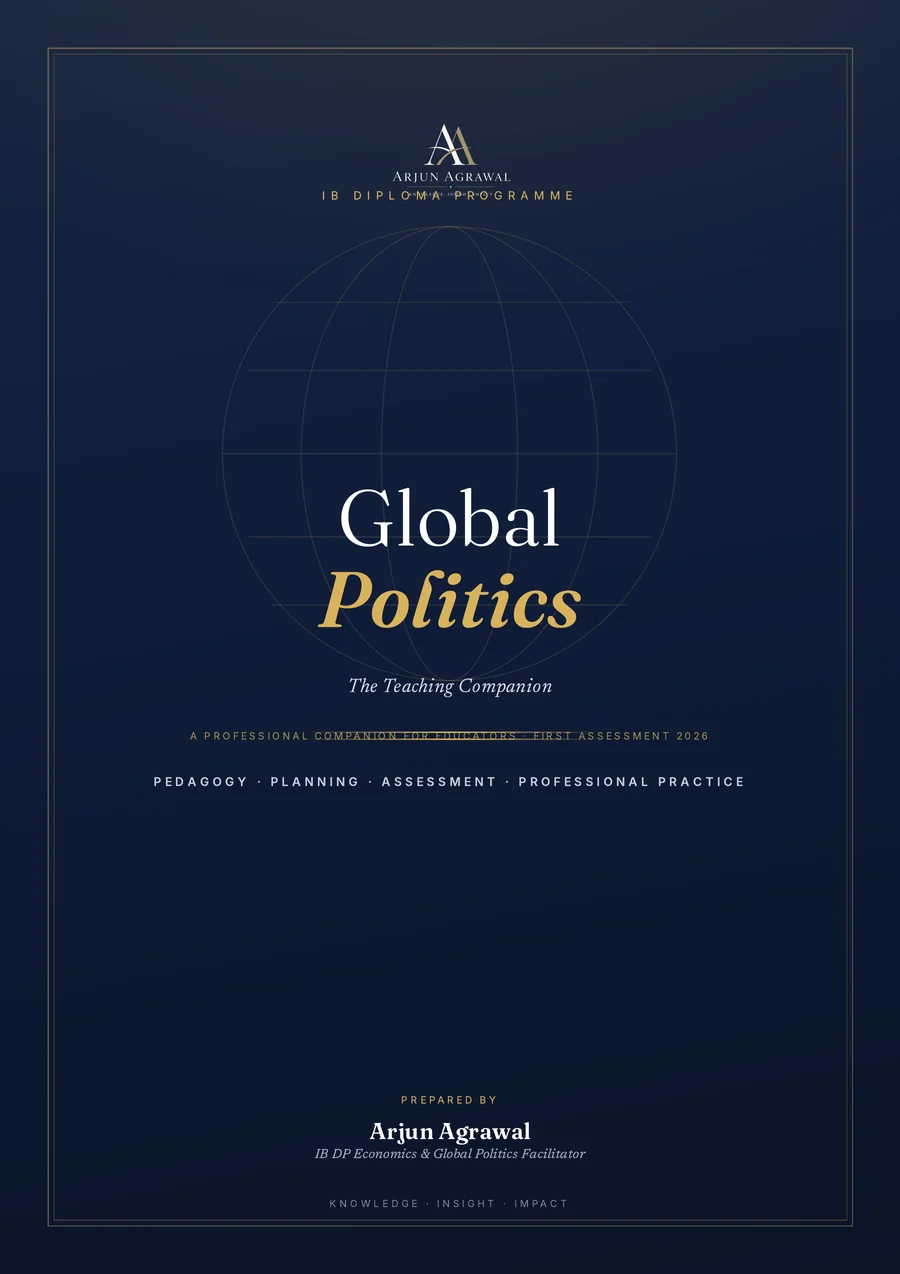
The Teaching Companion
How to teach IB Global Politics well: the subject's design turned into a teaching stance, with inquiry, the four concepts, course planning, classroom practice, assessment and case strategy.
For educators
This companion is written for teachers: assessment practice, marking judgement and the planning of a course. Only its cover and contents are shown here. The full companion is shared with teachers on request. For students, the platform turns its frameworks into original guidance in the assessment pages and the IB Essay Analysis Studio.
About this resource
The Teaching Companion is the professional counterpart to the Foundations & Course Companion: where that volume maps what students learn, this one is for those who teach it. It treats the course's design as conceptual, contextual, interdisciplinary and contested, and turns each feature into a teaching decision.
Its ten parts move from philosophy to practice. Early chapters set the political issue as the unit of teaching, teaching for transfer and international-mindedness, and the journey students make from narrating politics to arguing about it, with the misconceptions worth planning against. Chapters on inquiry cover its levels, a six-stage lesson cycle and the handling of controversial issues with committed impartiality. Each key concept, power, sovereignty, legitimacy and interdependence, receives an introduction, an analogy, a teaching progression and examiner advice, followed by a model for spiralling the concepts across two years.
Later parts address course planning and a defensible two-year sequence, discussion protocols, simulations and media literacy, teaching for each assessment component, feedback, the explicit teaching of analysis, evaluation and synthesis, case selection and sensitive topics, and professional reading. It closes with a completeness checklist for departments.
Topics covered
- Philosophy and design of the course
- Misconceptions and difficult concepts
- Inquiry-based teaching
- Teaching power, sovereignty, legitimacy and interdependence
- Two-year course planning
- Discussion protocols and simulations
- Media literacy
- Teaching Papers 1–3 and the engagement project
- Feedback and formative assessment
- Case selection and sensitive topics
Learning outcomes
- Plan a two-year course in which the key concepts spiral through every theme
- Design inquiry lessons around debatable, conceptual questions
- Run discussions and simulations with debriefs that carry the learning
- Teach analysis, evaluation and synthesis as distinct, assessable moves
Selected pages
The cover and contents only. The inner pages are for educators and are not shown publicly.